RUNNING SHOES and injuries
Updated: Jun 5, 2025

Despite the bright colour schemes and radical aesthetic design features, running shoes do more than just complete your look and protect your feet from cuts and abrasions.
Back in the day we chose a shoe based on our wet footprint, but that’s been superseded. Thank goodness for that. Pronators don’t need a big chunky brick on their feet.
But with more options than ever before, which shoes is best for you?
Just because ‘Joe Blo’ wears them doesn't mean they are right for you. One shoe doesn’t fit all.
Firstly, GO FOR COMFORT AND FIT. Features like impact attenuation (cushioning) and pronation control may be valuable (although proven not to be a significant cause of running injuries) but not if you don’t enjoy wearing the shoe.
Secondly, MIX IT UP. Use a variety of runners. It doesn’t cost more, they’ll last longer over time. By running every run in the same shoe, you subject certain structures to greater forces every step. Using two or three different shoes over your running program will redistribute those forces to different structures each run, reducing the likelihood of an overuse strain. (you still need to train smart, warm up, progress gradually, allow adequate recovery, …) Altering terrain and the course can also mix things up. Flats, hills, road, trail, oval, track…. Just build up slowly on new terrain, as you’ll load different muscles greater uphill vs downhill, or you’ll need more ankle stability on trails or running the curve of a track. But generally speaking, the common trend is more maximal shoes for longer runs, lighter shoes for speed work and shorter races.
Of course, don't run in basketball or tennis shoes or your casual sneakers.
THIRDLY, KNOW WHEN TO BIN YOUR FAVOURITE SHOES. Once a sneaker reaches its use-by-date a lot of its key features, especially the midsole cushioning and stability, no longer meet their desired purpose. Not only will your performance drop off, you run the risk of developing an injury. Standard sneakers last 600-1000km depending on individual. Super shoes with their high-tech foams don’t last anywhere near as long.
If you are prone to certain injury types, we can manipulate where the forces go, to some degree to off load those structures a little. But as I always harp on, a certain shoe (or orthotic) can’t eliminate forces, it just redistributes them. The following is a few of the main ways a shoe can redistribute load and aid injury management:
* Shoe drop/pitch refers to the difference in sole thickness between the heel and toe areas. For ease of understanding we’ll call 0-5mm as low, 6-12mm as high. Low drop shoes can decrease the loads experienced in the knee/hip, but at the expense of the foot and ankle and calf. Visa versa for high drop shoes, offloading the foot, ankle and calf but transferring more load up the limb.

* Shoe stack height refers to the midsole thickness. Minimal shoes reduce the load on the
knee but increase the strain on the foot, ankle and calf. Maximal shoes do the opposite.


Ideally, a runner suffering from Plantar fasciitis, Achilles tendinopathy or forefoot issues would benefit from time in a well cushioned, high drop sneaker.
Maximal shoes tend to be heavier, obviously, depending on the density of the midsole foam. Softer foam is lighter and gives more cushioning but will also degrade quicker. And they compress more, altering the actual stack height and pitch during gait. A heavier runner will also compress the material more than a lighter runner, meaning the foam in a shoe will behave differently for different runners and running styles. Softer foams can also be less stable.
Knee or hip injuries can benefit from a flatter, lower midsole. Just make sure your running gait can handle that. Ie a heavy heel striker on footpaths. Nor will a sore bunion like flexible thin soles.
Just be wary of the risk of creating a new injury to the opposing area that now bears more load. Ideally you should transition to different shoes, esp minimalist/barefoot shoes over a 12 week period, gradually increasing mileage and speed.
But when managing an injury, you probably should be reducing your running mileage/speed temporarily anyway to allow the body to heal. This should give you time to adapt. Targeted strength training can also help the transition ie calf raises as transition to a flatter shoe along with quad exercises for your sore knee. Another option is to gradually transition lower or higher in shoe features.
Another note on cushioning and maximal shoes. Our body uses proprioception and other feedback loops to monitor and adjust our running form as we run. Our body adapts to the running surface/ terrain, adjusting joint angles and leg stiffness during the stance phase to maintain its preferred movement pattern and centre of mass oscillation. Your muscle activation/effort varies over different terrain or with different footwear. The main argument against these maximal shoes is that they dial down our body’s natural protective mechanisms. Hence, we must still focus on good running form ie good knee/hip/ankle flexion to absorb shock as we land, not overstriding with straight knees thinking the extra rubber will absorb the impact.
Also be wary of how your foot and ankle behaves in some of the thicker, softer foam midsole shoes. These shoes can exaggerate how far your foot/ankle pronates or supinates as you run. Comparing your running from behind – barefoot/standard shoe vs a more super shoe can for some highlight a major red flag.
Another feature;
* Forefoot Rocker sole shoes with a rigid sole can help off load injured foot/ankle structures and promote a more efficient roll through during walking and running. Off loading injured heels, calves, Achilles tendons, shins. They also restrict the movement or strain through sore bunions, metatarsal bones or arthritis. Not so great for prolonged standing though. Or sports that require agility and lateral movements.
Note; most shoes have some forefoot curve, but if the forefoot is flexible the shoe doesn’t act as a rocker. Maximal shoes are generally stiffer due to thicker material.
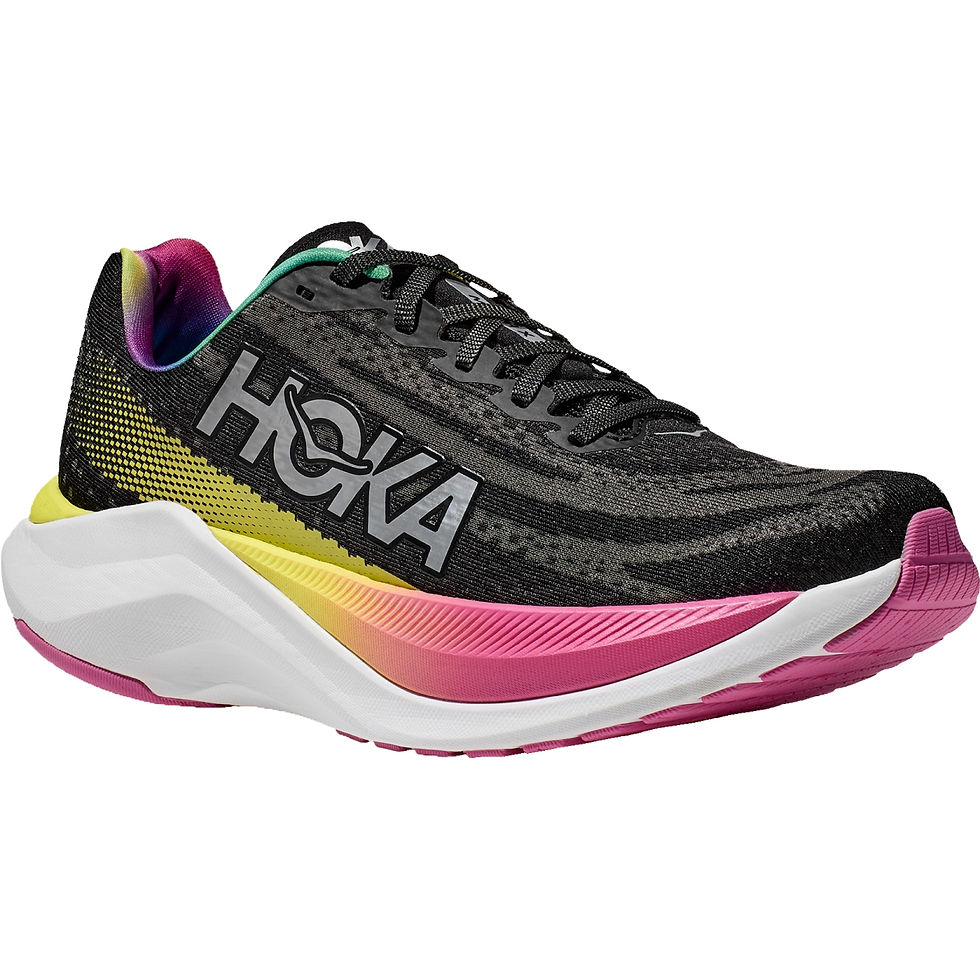
A rigid forefoot rocker will reduce some of the drive from the toes and their associated muscles.

To avoid a decrease in running performance especially at speed, the super shoes were developed with the internal carbon plate making up for this. Just be wary, prolonged use of a shoe that doesn’t engage certain muscles or load certain structures will over time weaken these tissues so it’s worth doing some barefoot stability/strength work. Ie calf raises, balance work, single leg exercises. Or mixing up your shoes.
Final note: Shoes aren’t the main factor in preventing a running injury. Previous running injury history is. And training too hard too often. So, seek professional advice and address your individual risk factors ie training errors, strength, diet… Time to break the injury cycle. And if you are injured - back off slightly (unload injury), address strength and mobility deficits and adjust your training program.
Hit myself up, or your local Podiatrist, for an individual assessment. Can’t beat a slo-mo video recording of you running on a treadmill.


Comments